
A historic proposal could reshape Canada–Europe relations in trade, defence, technology, energy, research and mobility — without Canada becoming a full member of the European Union.
For decades, Canada and Europe have maintained one of the world’s closest transatlantic relationships. But in September 2026, that relationship took an unexpected turn.
European Commission President Ursula von der Leyen publicly proposed opening the door for Canada to become the European Union’s first “associate member.”
The proposal was made during her State of the European Union address in Strasbourg on September 16, with Canadian Prime Minister Mark Carney in attendance.
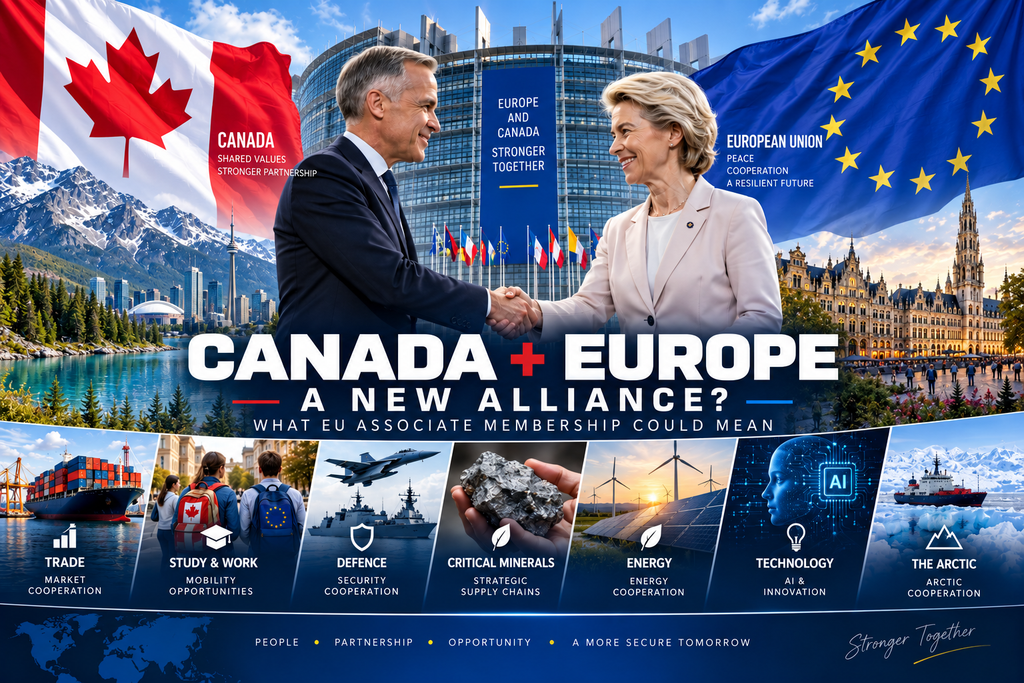
Von der Leyen said the EU wanted to move beyond the existing Canada-EU trade relationship toward what she described as an “alliance for the future,” covering areas including defence, technology, energy, critical minerals, artificial intelligence, quantum technologies, cybersecurity and the Arctic.
She then proposed working with Canada on becoming the EU’s first associate member.
The following day, Carney addressed the European Parliament and welcomed the ambition for a substantially deeper Canada-EU relationship.
But what exactly would associate membership mean?
That is where the story gets particularly interesting.
Canada Is Not Becoming a Full EU Member
First, an important distinction needs to be made.
Canada has not joined the European Union, and there is currently no agreement making Canada a full EU member.
The proposal concerns an entirely different concept: associate membership.
There is currently no established EU membership category by that name comparable to ordinary membership. The idea therefore raises major legal and institutional questions about what rights, obligations and access Canada might eventually receive. Reuters reported that the proposal is unprecedented and that its precise meaning remains to be worked out.
That means headlines claiming that “Canada is joining the European Union” go considerably further than the facts currently support.
What is happening is potentially historic, but it is still at the proposal and negotiation stage.
What Could EU Associate Membership Mean for Canada?
Although no final framework exists, speeches from both Canadian and European leaders provide clues about the areas they want to integrate more deeply.
Carney outlined a remarkably broad agenda before the European Parliament.
1. Easier Trade Between Canada and Europe
Canada and the EU already have a major economic foundation through the Comprehensive Economic and Trade Agreement (CETA).
The proposed relationship would attempt to go further.
Carney called for movement toward more seamless digital trade in non-agricultural goods and a wide range of services.
That could eventually reduce friction for Canadian and European companies operating across the Atlantic.
However, this should not be confused with Canada automatically entering the EU Single Market. No such arrangement has currently been agreed.
2. Canadians Could Gain More Opportunities to Study and Work in Europe
One of the most interesting elements for ordinary Canadians is mobility.
Carney specifically called for deeper people-to-people ties that would allow young Canadians and Europeans greater opportunities to live, work and study on either side of the Atlantic.
He also discussed potential Canadian participation in Erasmus+, the European Union’s major education and mobility programme.
If implemented, this could substantially expand educational and professional opportunities for younger Canadians.
But again, these are proposed areas of cooperation — not yet automatic rights for Canadians to live or work anywhere in the EU.
3. Canada and Europe Could Cooperate More Closely on Defence
Defence is another major component.
Canada and the European Union have already been moving toward closer defence-industrial cooperation, and Carney highlighted Canada’s participation in the EU’s SAFE framework while discussing the deeper partnership.
Von der Leyen has proposed further integration of Canadian and European defence industrial capabilities.
This matters because both Canada and Europe are trying to strengthen domestic and allied defence manufacturing and reduce vulnerabilities in strategic supply chains.
A deeper relationship could potentially give Canadian companies greater opportunities to participate in European defence procurement and industrial projects, depending on the eventual rules.
4. Canada’s Critical Minerals Could Become Strategically Important to Europe
Canada possesses significant reserves of critical minerals required for batteries, electric vehicles, semiconductors, clean technologies and defence systems.
Carney told the European Parliament that Canada has deposits of more than 30 critical minerals and argued that Canadian resources could complement European processing and manufacturing capabilities.
For Europe, the attraction is straightforward: diversified and politically reliable supply chains.
For Canada, the opportunity could extend beyond simply exporting raw materials.
Greater European investment could potentially support Canadian processing, infrastructure and manufacturing.
5. Energy Could Become Another Major Bridge
Energy security was another prominent part of Canada’s proposal.
Carney specifically mentioned Canadian LNG and hydrogen as potential contributions to European energy security.
The subject is already moving beyond speeches.
On September 20, French President Emmanuel Macron and Carney discussed deeper Canada-Europe energy cooperation, including the possibility of increasing Canadian LNG exports to Europe. Macron also expressed French support for Canada’s potential associate status with the EU.
That could make energy one of the most commercially significant elements of a future Canada-EU arrangement.
AI, Quantum Computing and Technology
The proposed partnership is not limited to traditional trade.
Canada and Europe are discussing cooperation in:
Artificial intelligence • Quantum technologies • Cybersecurity • Computing infrastructure • Space technology • Digital trade
Carney proposed joint work on AI safety protocols, common standards and transparency, as well as greater cooperation on computing capacity and digital infrastructure.
Von der Leyen similarly called for a Canada-EU technology alliance covering AI, quantum, cyber and economic security.
This suggests that any eventual Canada-EU framework could be much broader than a conventional free-trade agreement.
Why Is This Happening Now?
The timing is not accidental.
Canada is seeking to diversify its international economic relationships and reduce excessive dependence on any single market.
Europe is simultaneously looking for reliable partners in energy, critical minerals, defence, technology and global supply chains.
Carney described diversification as a way of increasing Canada’s resilience and sovereignty rather than pursuing economic isolation.
His argument was essentially that Canada does not need to become self-sufficient; it needs enough diversified relationships that no single external power can exercise excessive leverage over it.
The proposal also comes amid serious trade tensions between Canada and the United States.
U.S. President Donald Trump has already criticized the associate-membership proposal and threatened additional trade measures if he views deeper Canada-EU integration as hostile.
That adds a significant geopolitical dimension to what might otherwise look like an economic agreement.
Would Canada Actually Become Part of Europe?
Geographically, obviously not.
Politically and economically, however, the proposed relationship could bring Canada significantly closer to European institutions.
Canada already shares extensive economic, security, cultural and political ties with European countries.
The proposal would attempt to create a new institutional framework around those relationships.
But important questions remain unanswered.
Would Canada receive access to parts of the EU Single Market?
Would Canadians gain broader mobility rights?
Would Canada participate in certain European institutions or programmes?
Would it contribute financially to EU initiatives?
Would EU regulations apply to Canadian companies participating in integrated markets?
And perhaps the biggest question:
What does “associate member” legally mean?
At the moment, there is no complete answer.
That framework would have to be negotiated.
There Are Still Significant Obstacles
A dramatic announcement should not be confused with a completed agreement.
Canada and the EU still have unresolved trade issues, and even the existing CETA agreement has not been fully ratified by every EU member state.
Reuters noted on September 18 that deeper integration faces practical limits and that trade irritants remain in areas including telecommunications and dairy.
Creating an entirely new category of EU association could be considerably more complicated.
European governments would need to determine what associate membership actually includes, how it fits within existing EU law and what obligations Canada would accept in exchange for greater access.
In other words, this could become a major transformation — or ultimately a much narrower partnership carrying a dramatic new name.
The details will determine which.
What Happens Next?
For now, the important development is political.
The President of the European Commission has publicly opened the door.
Canada’s Prime Minister has publicly welcomed the initiative.
France has subsequently expressed support for Canada’s potential associate status.
Negotiations and political discussions will determine whether those statements eventually become a formal institutional arrangement.
Until then, Canadians should be cautious about claims that Canada has already “joined” the European Union.
It hasn’t.
But something unusual is clearly happening across the Atlantic.
For the first time, European leaders are openly discussing a relationship in which Canada could become the European Union’s first associate member.
If that idea becomes reality, it could represent one of the biggest changes in Canada-Europe relations in generations.
BQ Global — Key Takeaway
Canada is not joining the European Union as a full member.
Instead, Canada and the EU are exploring an unprecedented form of associate membership or deeply integrated partnership.
Its final structure remains undefined, but discussions already cover trade, defence, critical minerals, energy, AI, research, financial services and opportunities for Canadians and Europeans to study and work across the Atlantic.
What began as a trade relationship could eventually develop into something considerably broader.
And the next question is no longer simply whether Canada is becoming closer to Europe.
It is how close Canada and Europe ultimately decide to become.